
Ajita Insights | An analysis of the intersection between master craftsmanship and strategic legacy management through Cartier’s "En Équilibre" collection.
Legacy and Evolution: A Lesson in Consistency
The latest collection—En Équilibre—is not merely a creative endeavor; it is a masterclass in Legacy Stewardship. Cartier has established a lineage extending from its greatest icons:
- 1914: The debut of the Panthère, transforming a natural predator into a symbol of feline power and sophistication.
- 1920s - 1930s: Art Deco creations defined a new modernism where geometry dictated beauty.
En Équilibre does not repeat history; it reinterprets it. This is how an empire grows: evolving in form while remaining constant in identity.
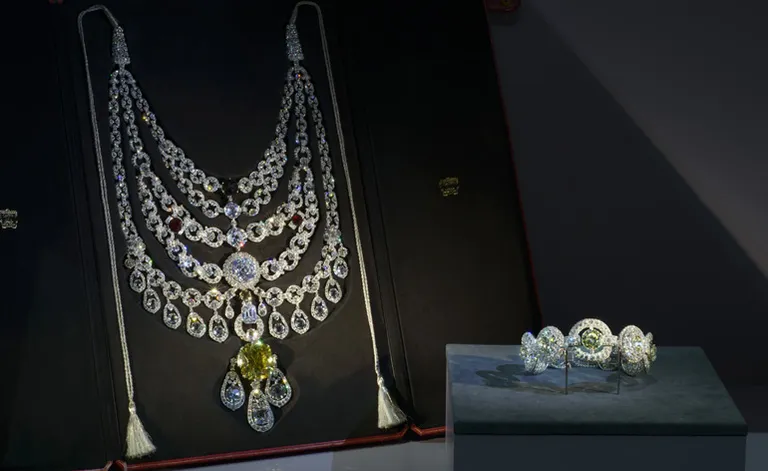
"Yet, the equilibrium Cartier achieves today is not a mere artistic coincidence; it is the refinement of a century-long Institutional Memory. To truly grasp how the Maison masters 'balance through excess' in 2025, one must look back to 1928—the moment Cartier executed one of the most audacious 'power contracts' in jewelry history: The Maharaja of Patiala’s necklace. This was more than a commission; it was a strategic maneuver that codified a new standard of influence on the global geopolitical stage."
The Strategic Commission: Defining the "Patiala Standard"
When the Maharaja arrived in Paris in 1925 with trunks of precious stones—including the legendary 234.69-carat De Beers diamond—he was not merely seeking a jeweler; he was seeking an Institutional Architect.
By choosing Cartier, the Maharaja engaged in a strategic partnership to translate Indian princely grandeur into a Western-modernist visual language. This was a move of Cultural Sovereignty: ensuring that his personal and state identity could command absolute respect in the salons of Paris and the courts of the British Empire alike.
Technical Supremacy: The Anatomy of 1,000 Carats
The sheer technical scale of the Patiala Necklace remains a benchmark for high-jewelry engineering:
- The Anchor Asset: At its heart sat the De Beers diamond, the seventh-largest polished diamond in the world at the time. In asset management terms, this was the "central bank" of the piece, around which all other values revolved.
- The Volume of Influence: Set in platinum, the necklace carried 2,930 brilliant-cut diamonds and two Burmese rubies.
- The Gravity of Power: With a total weight of approximately 1,000 carats, the necklace was not designed for comfort, but for Presence. It was a ceremonial burden—a literal weight of sovereignty that demanded a specific posture of command from the wearer.

Legacy Stewardship: From Disappearance to Restoration
The history of the Patiala Necklace is also a cautionary tale in Legacy Stewardship. Following the turmoil of the mid-20th century, the necklace disappeared, only to resurface decades later in a fragmented state.
Cartier’s subsequent purchase and four-year restoration of the piece (using cubic zirconia and synthetic stones to replace the missing original diamonds) was an act of Institutional Memory. It proved that while the physical stones may be dispersed, the Narrative Asset—the "Idea" of the Patiala Necklace—is a permanent part of the Cartier heritage and the history of jewelry.
The Ajita Note: Assets as Artifacts
The Patiala commission teaches us that the ultimate legacy is one that cannot be ignored. For the modern mogul, the lesson is clear: true wealth must be articulated through a Strategic Narrative. Whether it is a digital empire or a 1,000-carat necklace, the goal is the same—to create an object or an institution so technically supreme and culturally significant that it becomes a permanent pillar of the global story.

Strategic Takeaway: True sovereignty is not just possessed; it is performed. The Patiala Necklace was the ultimate performance of a legacy that refused to be diminished.


